Compensate your emissions with
BLUE Carbon Credits
What are Blue Carbon Credits?
Traditional Carbon credits are tradable certificates or permits that represent a right to emit a certain amount of carbon dioxide (CO₂) or an equivalent amount of another greenhouse gas. One carbon credit is equivalent to the right to emit one tonne of CO₂.
Carbon Credits are mainly generated by land-based projects such as forestry and renewable energy projects (solar, wind, biomass)
Blue Carbon Credits
Blue carbon credits are a subset of carbon credits that specifically target the carbon sequestered by coastal and marine ecosystems, such as mangroves.
The major advantage of this is that mangroves store up to 5 times as much CO₂ as tropical forests and up to 10 times as much as mature tropical forests. Most coastal blue carbon is stored in the soil, not in above-ground plant materials as with tropical forests.
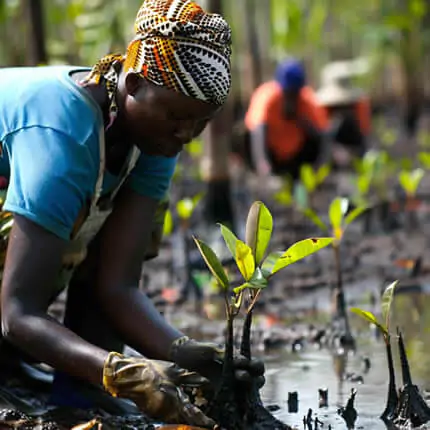
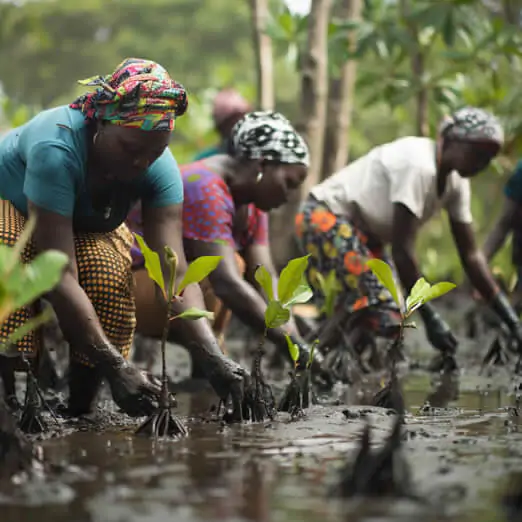
BLUE Carbon Credits Foundation is mainly concerned with the planting, protection and preservation of mangrove forests in the Republic of Guinea in West Africa (formerly French Guinea). Through exclusive agreements with the government of Guinea, BLUE CC Foundation has obtained the rights to restore mangroves, which have been decimated by human activity. The condition is that a large part of the proceeds from Carbon Credits flow back to the local population.
Over 1,000 hectares of mangroves have already been planted and we now have permission to plant a further 12,000 hectares of mangroves, starting in November 2024.
In this way, we not only ensure that CO₂ is stored in the mangroves, but we also help the local population with income from work, training and much-needed facilities.

As a company, why should you buy Blue carbon Credits?
Blue carbon credits, which come from projects aimed at protecting and restoring coastal and marine ecosystems such as mangroves offer several benefits to businesses. Here are some of the main benefits:
- Sustainability and Social Responsibility: By buying blue carbon credits, companies can show their commitment to sustainability and the environment. This can improve their image and make them more attractive to environmentally conscious consumers, investors and partners.
- Meeting climate commitments: Blue carbon credits help companies reduce their carbon footprint and meet their obligations under voluntary or mandatory carbon schemes. This can help meet regulatory requirements or achieve targets set in sustainability programmes. From 1 July, large companies with more than 100 employees are required to report all kilometres driven by employees from home, work and business travel! The aim is to identify and then reduce emissions.
- Compliance and Anticipating Future Regulations: As more countries start implementing stricter climate regulations, companies that have already invested in blue carbon credits can be better prepared for new requirements and regulations, avoiding future costs and complications.
These benefits mean blue carbon credits can be a valuable part of the strategies of companies looking to reduce their environmental impact and contribute to a more sustainable future.
The certificates are not currently available for sale from Blue Carbon Credits Foundation but to stay informed you can subscribe to our newsletter.


Guinea government support
Through agreements with the Guinean government and local authorities, Blue Carbon Credits Foundation is able to plant a total of 60 hectares of mangrove forests in Sangareah Bay. Blue Carbon Credits will be issued for the planted forests.
Support local people
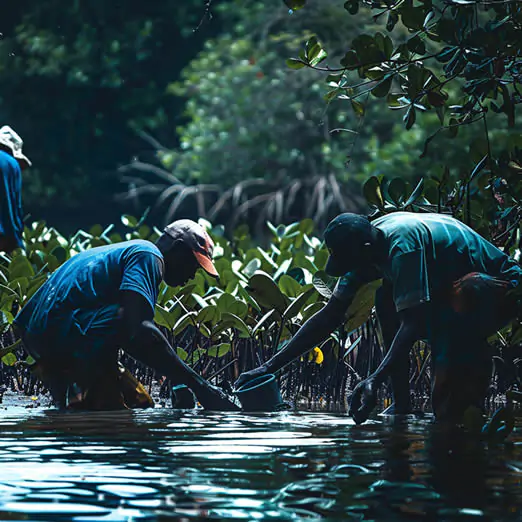
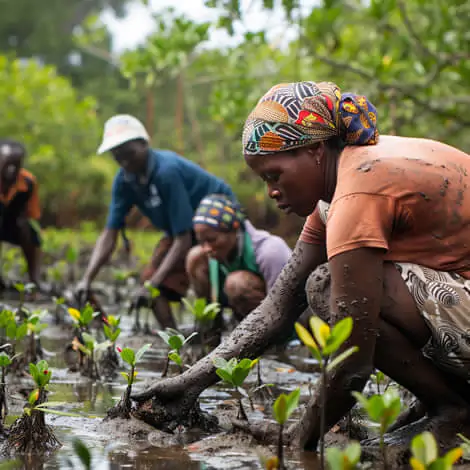
We work with local people to plant and protect new mangrove forests. This provides income and new amenities and better future prospects for the people of Sangareah Bay , Guinea.
Already proven projects
In recent months, 2.5 hectares of mangrove have been planted. This planting is being translated and converted into Blue Carbon Credits which will soon be offered via this website. The planning before 2025 is to plant another 20 hectares.
Protecting mangroves
With the proceeds from Carbon Credits, we not only plant new mangroves but also protect already planted mangroves from logging.